
Glossary
Tree and Arborist Glossary
Collar, crown, girdling root: the words arborists use, explained in plain English. Search or scroll.
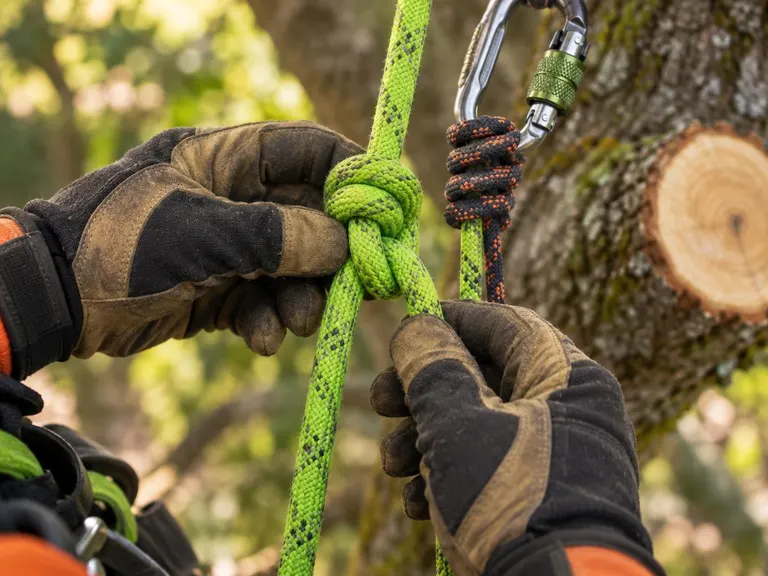
- Arborist
- A tree professional who studies, diagnoses and cares for individual trees, including pruning, treatment and removal.
- Bracing
- Installing rods through a split or weak union to hold it together.
- Branch collar
- The slightly swollen ring where a branch joins the trunk. Pruning cuts are made just outside it so the tree can seal the wound.
- Cabling
- Installing flexible steel cables in a tree's canopy to support weak branches or unions.
- Cambium
- The thin living layer just beneath the bark that makes new wood and new bark each year.
- Canker
- A dead, often sunken area on a branch or trunk caused by disease or injury.
- Canopy
- The upper layer of a tree or a group of trees, made of branches and leaves. Also called the crown.
- Chlorosis
- Yellowing of leaves while the veins stay green, often a sign of a nutrient or soil problem.
- Co-dominant stems
- Two trunks of about equal size growing from the same point. The join is often weak and can split in storms.
- Conk
- A shelf or bracket-shaped fungus growing on a tree. It can indicate decay inside the wood.
- Critical root zone
- The area around a trunk where roots must be protected from digging, paving and compaction. A common guideline is one foot of radius per inch of trunk width.
- Crown raising
- Removing the lowest branches to create clearance above lawns, drives, roofs and sidewalks.
- Crown reduction
- Shortening the height or spread of a tree by cutting branches back to suitable side branches.
- Crown thinning
- Selective removal of branches throughout the canopy to let in light and air and reduce wind load.
- Deadwooding
- Removing dead, dying and broken branches from the canopy.
- Dormant season
- The time of year, usually late fall to late winter, when a tree is not actively growing and leaves are off.
- Drip line
- The edge of the canopy where water drips to the ground. Many roots reach at least this far.
- Emerald ash borer
- A metallic green beetle whose larvae kill ash trees by feeding under the bark.
- Epicormic shoots
- Thin shoots that sprout from the trunk or main limbs, often after stress, heavy pruning or damage.
- Girdling root
- A root that wraps around the trunk or another root and slowly squeezes it, cutting off water and nutrients.
- Hazard tree
- A tree with defects that make failure likely, and with something of value in the path it could hit.
- Heartwood
- The dense, inner wood of a tree that no longer carries water but provides strength.
- Included bark
- Bark pushed inside a tight union between two stems. It prevents a strong connection and often leads to splitting.
- Leader
- The main upward-growing stem of a tree. A strong, single leader is usually a good sign in a young tree.
- Mulch volcano
- Mulch piled high against a trunk. It holds moisture against the bark, can cause rot, and should be avoided.
- Oak wilt
- A fungal disease of oaks that spreads through wounds and connected roots and can kill a tree within weeks.
- Pollarding
- A pruning method that repeatedly cuts young branches back to the same points to keep a tree small.
- Rigging
- Using ropes, pulleys and friction devices to lower branches and trunk sections safely.
- Root flare
- The widening at the base of the trunk where roots begin. It should be visible at the soil line.
- Scaffold branches
- The main, permanent branches that form the framework of a tree.
- Topping
- Cutting large branches back to stubs. It is harmful, creates weak regrowth and is not good arborist practice.
- Widowmaker
- A broken or dead branch caught in a tree that could fall without warning.
No match. Try a shorter word.
Still have a question about a tree?
Describe it to us and we will explain it in plain English.